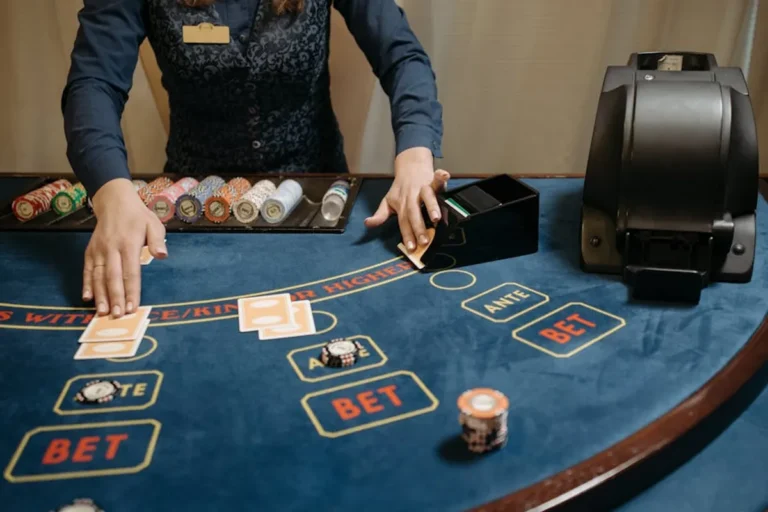

When selecting a table game, understanding the core mechanics and player agency involved in options like Blackjack, Roulette, and Baccarat is crucial for a productive initial experience. Each game presents a distinct blend of chance, strategy, and pace, directly influencing the entertainment value and potential outcomes for a newcomer. This guide outlines the foundational aspects of these popular choices, allowing you to weigh their characteristics before engaging. If you're intrigued by the spin of the wheel, our online roulette guide explains how roulette works.
Understanding Blackjack Fundamentals
Blackjack is a card game where the objective is to have a hand total closer to 21 than the dealer's hand, without exceeding 21. Each card holds a specific value: numbered cards (2-10) are worth their face value, face cards (Jack, Queen, King) are worth 10, and an Ace can be worth either 1 or 11, depending on which value benefits the hand most without busting.
Player Actions and Strategic Considerations
After receiving two initial cards, players have several options to improve their hand:
- Hit: Take an additional card.
- Stand: Decline additional cards, keeping the current hand.
- Double Down: Double the initial bet and receive exactly one more card. This option is typically available only on specific hand totals.
- Split: If the initial two cards are a pair, players can split them into two separate hands by placing an additional bet equal to the original. Each hand is then played independently.
The dealer, by contrast, operates under strict rules, usually hitting on any hand 16 or less and standing on all 17s (some variations include "soft 17," where the dealer hits on a 17 that includes an Ace counted as 11). Understanding these dealer rules is central to developing a basic strategy, which involves making mathematically optimal decisions for every possible player hand against every possible dealer upcard. Adhering to basic strategy significantly reduces the house edge, making Blackjack one of the more favorable games for informed players.
Best for: Players who enjoy a blend of chance and strategic decision-making, and are willing to learn basic strategy to improve their odds.
Exploring Roulette Mechanics
Roulette is a game of pure chance centered around a spinning wheel and a small ball. The wheel is divided into numbered and colored pockets (typically red, black, and green for zero/double zero). Players place bets on where they predict the ball will land after the wheel stops spinning.
Betting Options and Payouts
The roulette table layout offers a wide array of betting options, broadly categorized into "inside" and "outside" bets:
- Inside Bets: Placed directly on specific numbers or small groups of numbers. These bets offer higher payouts but have lower probabilities of winning. Examples include a single number (straight up), two numbers (split), three numbers (street), or four numbers (corner).
- Outside Bets: Placed on broader categories, offering lower payouts but higher probabilities of winning. Examples include red/black, odd/even, high/low (1-18 or 19-36), dozens (1st 12, 2nd 12, 3rd 12), and columns.
The house edge in Roulette is determined by the presence of the green zero pockets. A single-zero wheel (often referred to as European Roulette) has a lower house edge than a double-zero wheel (American Roulette) due to fewer zero pockets, which always favor the house. No amount of strategy can alter the inherent odds of each spin; every round is an independent event.
Pro Tip: For beginners in Roulette, focusing on outside bets (like red/black or odd/even) offers a higher frequency of smaller wins, providing a longer and more consistent initial experience while you familiarize yourself with the game's flow.
Best for: Players who prefer straightforward gameplay based entirely on chance, with no complex decisions required beyond initial bet placement.
Baccarat: Simplicity and Elegance
Baccarat is often perceived as a sophisticated game, yet its core rules are among the simplest to grasp. The objective is to bet on which of two hands—the "Player" or the "Banker"—will have a total closest to nine. A third option, "Tie," is also available.
Card Values and Hand Scoring
In Baccarat, cards are valued as follows:
- Aces are worth 1 point.
- Cards 2 through 9 are worth their face value.
- Tens and face cards (Jack, Queen, King) are worth 0 points.
To calculate a hand's total, the values of the cards are added together, and if the sum is 10 or more, only the second digit is considered. For example, a hand with a 7 and a 6 totals 13, which becomes 3 in Baccarat. A hand with a King and an 8 totals 8. The game follows a strict set of rules for drawing additional cards, which are automatically applied, meaning players make no drawing decisions after placing their initial bet.
The house edge in Baccarat is notably low, especially on the Banker bet (typically around 1.06%, though a commission is usually taken on winning Banker bets). The Player bet has a slightly higher house edge (around 1.24%), and the Tie bet carries a significantly higher house edge (often over 14%), making it less favorable for consistent play.
Best for: Players seeking a game with minimal decision-making, a fast pace, and a relatively low house edge on specific bets.
Choosing Your First Game: Key Considerations
When deciding which game to try first, consider these factors:
- Strategic Depth: Blackjack offers the most strategic depth, rewarding players who learn and apply basic strategy. Roulette and Baccarat are primarily games of chance, with no player decisions influencing the outcome after the bet is placed.
- Pace of Play: Baccarat and Roulette can be very fast-paced, with rounds completing quickly. Blackjack's pace can vary depending on the table and the number of players, but individual decision-making introduces pauses.
- House Edge: With optimal basic strategy, Blackjack can offer one of the lowest house edges. Baccarat's Banker bet also provides a consistently low house edge. Roulette's house edge is generally higher, particularly on double-zero wheels, and remains constant regardless of betting patterns.
- Engagement Style: If you prefer active participation and decision-making, Blackjack is a strong choice. If you enjoy observing and letting chance dictate the outcome, Roulette or Baccarat might be more appealing.
Ultimately, the "best" game is subjective, aligning with your preferences for engagement, strategic involvement, and tolerance for risk. Each offers a distinct experience, providing a foundation for understanding broader table game dynamics.
Frequently Asked Questions
Is Blackjack purely a game of skill?
While Blackjack involves significant strategic elements that can reduce the house edge, it remains a game of chance as card distribution is random. Skill comes into play through informed decision-making based on probabilities.
Which of these games offers the best odds for a beginner?
For beginners, Blackjack with basic strategy or Baccarat (specifically betting on the Banker) typically offers the most favorable house edge, meaning the game's inherent advantage for the house is lower over time.
Can I influence the outcome in Roulette?
No, Roulette is a game of pure chance. Once the ball is spun, its landing position is random, and no betting strategy can alter the fundamental odds or influence the outcome of individual spins.
Are these games difficult to learn?
Baccarat is arguably the easiest to learn due to its automated drawing rules. Roulette's betting options are numerous but simple to understand individually. Blackjack requires learning card values and basic strategic decisions, which takes a bit more effort but is highly rewarding. For those seeking the simplest path, understanding how live baccarat plays out can be a good starting point.